LORAMI: Low-Rank Adaptation for Multi-Identity Physics-Based Face Rigs
Computer Graphics Forum (Proc. ACM/EG SCA 2026)
Abstract
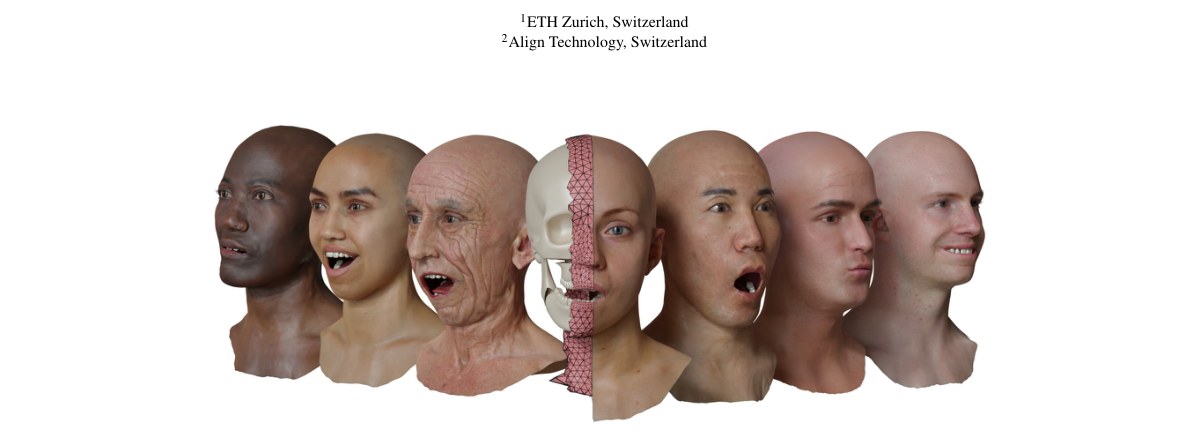
Physics-based simulation can augment facial rigs with high-quality deformations, but at steep computational costs. While neural surrogates can substantially reduce computation time, existing methods do not generalize across identity variations and instead require expensive per-case retraining. In this work, we present LORAMI—a method for learning physics-based face rigs over a continuous space of identities using low-rank adaptation. LORAMI addresses the challenge of identity variation through a novel architecture that combines a shared neural surrogate with low-rank weight adaptations. Instead of training a dense model across identity space, we modulate a shared base network using low-rank factors. These factors are scaled by diagonal matrices predicted from identity parameters. This design enables efficient modeling of identity-dependent variations while preserving the generic deformation behavior of the underlying physics-based rig. Our experiments show that LORAMI achieves deformation accuracy on par with single-identity models and outperforms fully dense identity-conditioned networks. As a result, our method enables real-time physics-based facial animation with continuous identity control.
BibTeX
@article{Corigliano2026LORAMI,
  title   = {LORAMI: Low-Rank Adaptation for Multi-Identity Physics-Based Face Rigs},
  author  = {D. Corigliano and D. Peter and B. Solenthaler and B. Thomaszewski},
  journal = {Computer Graphics Forum (Proc. ACM/EG SCA 2026)},
  year    = {2026}
}