A Unified Homogenization Framework for Straight- and Curved-Crease Origami Materials
ACM Transactions on Graphics (Proc. ACM SIGGRAPH 2026)
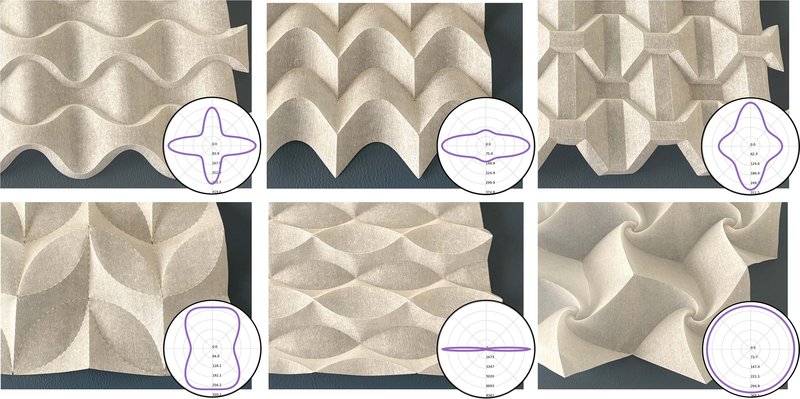
Abstract
We present a computational framework for numerical homogenization of origami materials---thin sheets structured with periodic crease patterns that, once folded, exhibit diverse and often unusual mechanical properties. Whereas the in-plane stiffness of conventional sheet materials is typically orders of magnitude larger than their resistance to bending, origami-based folding introduces geometric structure that can drastically reshape both bending and stretching behavior. However, predicting how a particular crease pattern gives rise to effective macroscopic properties remains challenging due to the complex coupling of crease geometry, folding kinematics, and surface deformations. In this work, we introduce a computational framework that integrates simulation-based folding and numerical homogenization to explore the relationship between crease pattern and effective material behavior. To describe the macromechanical response of origami materials, we employ a quadratic energy model based on Classical Laminate Theory, together with a simplified treatment of crease plasticity. Our unified representation accommodates both straight- and curved-crease designs, revealing a rich space of origami materials with diverse behavior. In particular, we examine how pattern symmetry governs material symmetries, demonstrating examples that span the full spectrum from perfectly isotropic to highly anisotropic membrane and bending responses. Our framework further enables controlled exploration of parameter variations, illustrating how geometric features such as crease curvature shape macroscopic mechanical behavior. We showcase the potential of this approach through a broad set of examples, ranging from canonical straight-crease patterns such as Miura-ori to complex curved-crease tessellations. While a quantitative analysis is left for future work, we validate our homogenized descriptions against native-scale simulations and qualitatively compare deformation behaviors with real-world prototypes.
BibTeX
@article{Li26AUnified,
  title = {A Unified Homogenization Framework for Straight- and Curved-Crease Origami Materials},
  author = {Li, Mingjie and Montes Maestre, Juan Sebastian and Ganier, Emilien and Mundilova, Klara and Pauly, Mark and Thomaszewski, Bernhard},
  journal = {ACM Transactions on Graphics (SIGGRAPH '26)},
  year = {2026}
}